What Is a Construction Daily Log?
A construction daily log is the day-by-day record of what actually happened on site. When it’s done right, it becomes the backbone for accurate billing, cleaner closeout, and fewer “that’s not what happened” arguments later.
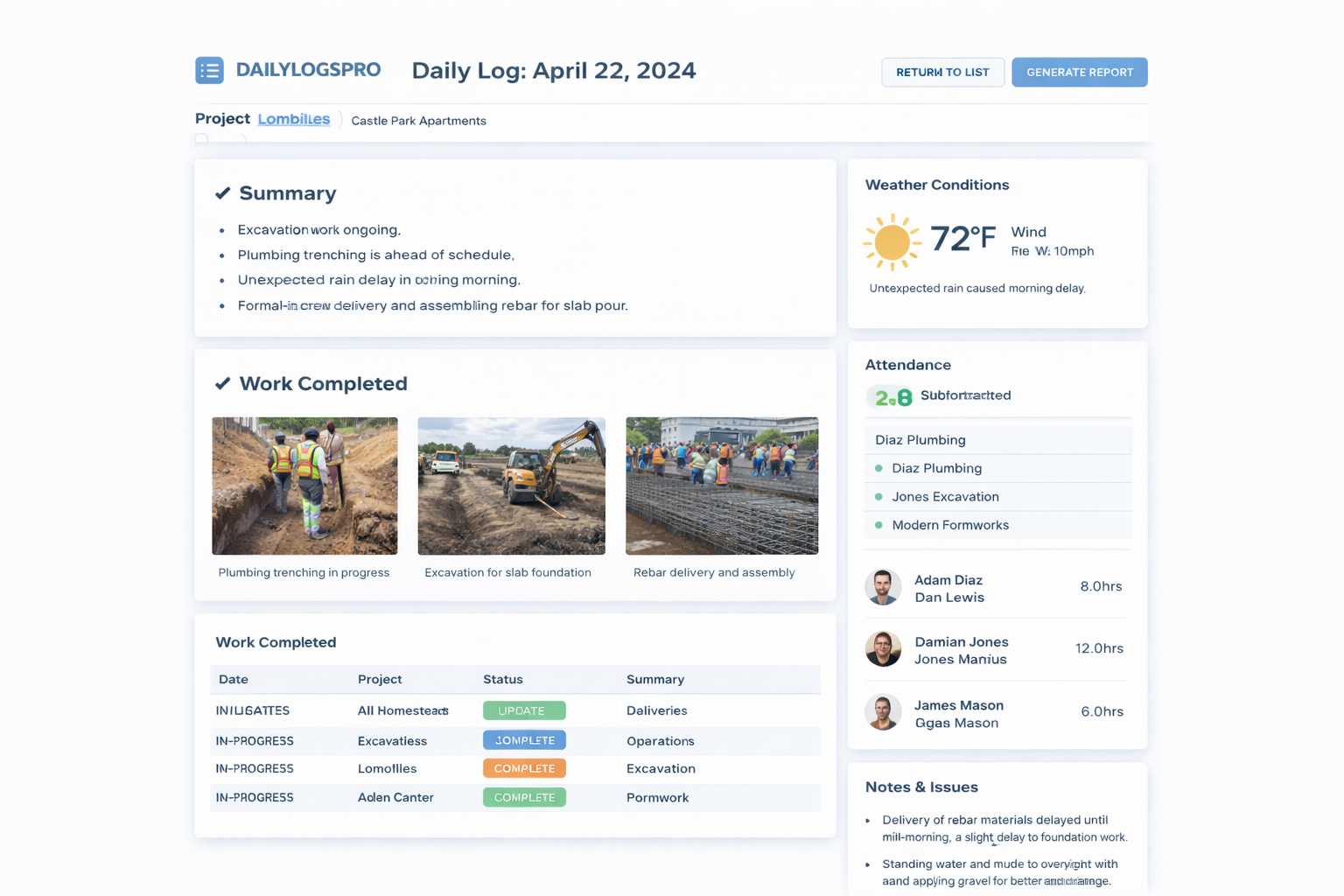
Definition: construction daily log
A construction daily log (sometimes called a daily report) is a record of jobsite activity for a specific date. It captures the facts that matter: work performed, who was on site, site conditions, deliveries, inspections, delays, and issues.
If you only remember one thing:
Daily logs aren’t for “later.” They’re for today. The value is accuracy and timeline—captured while it’s fresh.
Why daily logs matter (even when everyone is busy)
Most teams start daily logs because someone “requires them.” The teams who keep them long-term do it because daily logs make real problems smaller:
- Billing backup: support percent complete with a credible day-by-day record.
- Delay documentation: weather, access issues, inspections, and trade coordination problems.
- Dispute defense: timelines, conditions, and what was actually done.
- Closeout sanity: fewer missing details when the job is winding down.
If your pay app ever gets questioned, daily logs become the receipts. (And yes, this is why we designed DailyLogsPro to work alongside PayAppPro and LienWaiverPro.)
Who should fill out the daily log?
The best answer is: the person closest to the work. In most companies, that’s a superintendent or foreman. In some, it’s a PM. What matters is consistency and accuracy.
- Superintendent: best overall jobsite picture
- Foreman: strongest work detail for their scope
- PM: good for coordination + contractual notes
What to include in a construction daily log
You don’t need a novel. You need the repeatable essentials. Here’s the practical checklist:
Basics
- Date + project
- Who submitted
- Work performed (plain language)
- Crew counts (by trade if needed)
Conditions
- Weather + site conditions
- Access limitations
- Inspections / testing
- Safety notes (if relevant)
Events
- Deliveries
- Equipment onsite
- Subcontractors present
- Coordination issues
Proof
- Photos with short captions
- Notes on delays + root cause
- What was blocked (and why)
- Anything that will matter in 30 days
Want the deeper checklist? See: What to include in a daily report.
Template vs software (quick reality check)
Templates are fine… until they aren’t. The biggest failure isn’t formatting — it’s consistency. Software helps because it makes “doing it right” the easiest option.
The 3 reasons daily logs fall apart:
- They get filled out days later
- Photos are scattered and unlabeled
- There’s no standard checklist—so key details vanish
If that sounds familiar, you’ll like what we’re building. DailyLogsPro is planned for launch in Q2 2026.
FAQ
Related guides
- What to include in a daily report
- Common daily log mistakes
- Template vs software
- How daily logs support pay apps
DailyLogsPro (Q2 2026)
Verified field reporting: weather, crew counts, photos, notes, and geo/time capture — built to support billing and reduce disputes.
Get Launch AlertsBuilt by Morton Technologies LLC (Metro Detroit).